

A hair topper looks natural when its part meets yours, the front edge blends into your hairline, and the added lengths fall with the hair underneath. Start by finding the exact join that looks wrong. A raised front needs a fitting adjustment; a flat but visible join needs better blending. Color and texture mismatches need a different approach again.
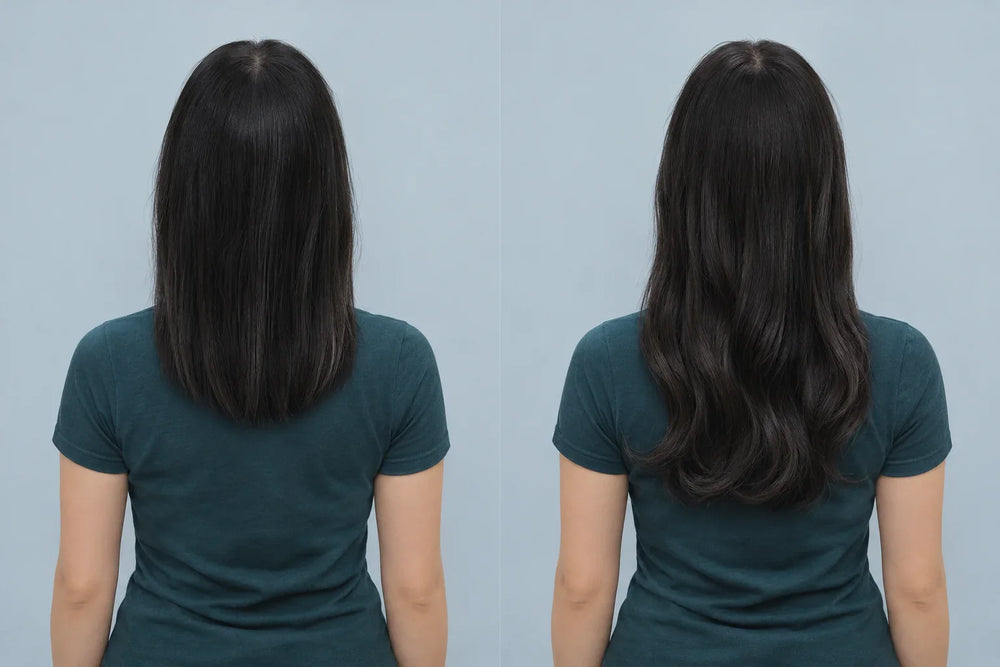
For EWIGSC's synthetic silk-base toppers, match your own hair to the supplied straight or wavy finish, then refine the front and side transitions.
Find the join your eye keeps noticing
Look at your fitted topper in daylight, then turn to each side with a second mirror. Let your hair fall as you normally wear it. For this first check, leave concealer, styling spray and scissors aside so you can see what needs changing.
| What stands out | What to check | Start here |
|---|---|---|
| A lip or shadow at the front of the part | Is the base actually raised, or is a flat edge simply exposed? | Refit a raised front. Blend your own front hair across a flat edge. |
| Two separate scalp lines | Where your own part meets the topper's part | Bring those lines together before arranging the lengths. |
| A dark, pale or reddish band | The color of the hair meeting at the join | Compare the two in the same light. Moving the topper won't change its shade. |
| A fuller top sitting above thin or differently textured ends | The side profile, wave pattern and where each layer finishes | Separate the lengths gently, then decide whether the texture or cut needs changing. |
How do you hide the front of your hair topper?
For a front that blends with your existing hairline, leave usable front hair outside the base and bring it into the topper hair. The amount and position depend on where your thinning starts and where the clips can attach comfortably.
First, settle a lifting front
Look at the forward end of the part. An edge curling upward creates a small shadow underneath it. More hair combed over that spot may hide it briefly, but the raised base still needs attention.
Support the base and reopen the clips that are pulling on the front. Let it rest flat, check that your own hair isn't bunched beneath it, and refasten without stretching it backward. Release any clip that pinches. Our hair topper fitting guide shows the fastening and removal sequence, including a lifted-versus-flat front comparison.
Then blend across the flat edge
Set aside the front hair you want visible before closing the clips. Once the base is secure, use your fingertips to lay a small section of that hair back or diagonally into the topper's front lengths, following your usual hairstyle. Bring the two together where they meet; you don't need to comb your entire hairline straight backward.
Keep one hand supporting the base while arranging nearby hair. Use fingers near the attachment points and a wide-tooth comb through the free lengths. If a stroke catches or pulls, stop and free that section instead of dragging through it.
A relaxed side sweep can cover a transition that an exposed center part leaves visible. Check the new direction from the side: it should cover the front without lifting the base or pulling the clips. When the hair falls back into place after you turn your head, the arrangement is working.
If there is too little front hair to blend
You need enough remaining hair to cover the intended join and support the clips. Repeatedly borrowing wispy strands from farther away can leave another area exposed.
The American Hair Loss Association distinguishes closed-front toppers, which blend behind existing frontal hair, from lace-front designs that create a visible frontal hairline. A silk top gives a scalp-like appearance through the part; that feature alone doesn't create a lace front.
If your goal is a completely exposed hairline and your remaining front hair cannot conceal the edge, choose a design made for that result. Our hair topper versus wig guide explains when fuller coverage is the more useful option. Adding glue to an EWIGSC clip-in silk base isn't a substitute for a different front construction.
Make the part continue into your own hair
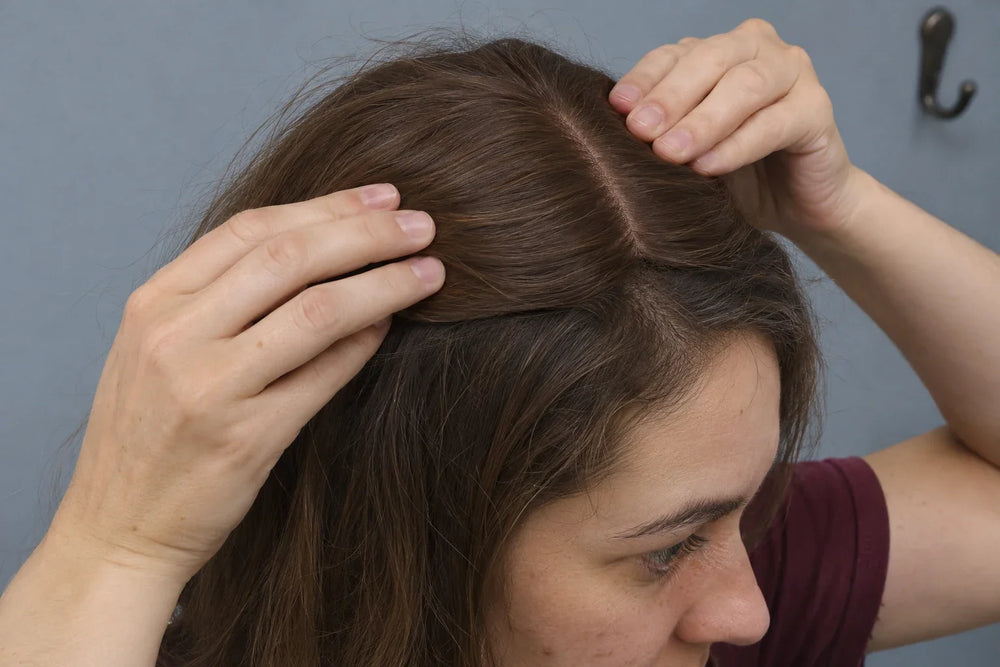
A believable part has a continuous direction at the join. Two individually neat parts can still look disconnected if one starts to the left of the other.

Begin with your own part arranged as you intend to wear it. Position the topper so its visible part meets that line, then check the coverage before fastening. If the lines don't meet, reopen the clips and move the piece slightly. Avoid twisting a secured base to force the part into place.
After fitting, separate a few front strands gently with your fingers to soften an abrupt division. Keep the existing parting area intact. You don't need to widen the scalp line or make a zigzag part to achieve a natural finish.
EWIGSC's silk bases create a scalp-like surface beneath the part. Our silk-base topper guide explains that construction. During blending, focus on where this surface meets your own visible scalp and hair. Widening the part by plucking can't correct an offset join.
Match the hair that will actually remain visible
Compare the topper with the hair beside your face and along the sides, including any roots you plan to leave out. Matching only the ends can miss a noticeable difference at the front.
Check lightness first, then warmth. Two shades can both be called brown while one looks coppery and the other looks cooler. Hold the topper beside your own hair in the same daylight and look at the meeting point. Repeat in the indoor light where you'll usually wear it. A photo taken under a warm lamp is a poor comparison for hair photographed beside a window.
When comparing product photos, turn off warm screen filters. Apple explains that Night Shift shifts display colors toward warmer tones. That matters when you're deciding whether a shade looks golden or neutral; a screen comparison still can't reproduce every detail of the physical hair.
Rooted shades can work when their darker root color connects with the roots you leave visible. Compare the lighter lengths too. A matching root doesn't solve a strong contrast through the sides.
If the color difference forms a clear band, select a closer factory shade. Regular hair dye and bleach are unsuitable fixes for EWIGSC synthetic fiber. A small cosmetic touch at the join also won't recolor a whole topper.
How to blend a hair topper through the sides and ends
Prepare your own hair in the finish you plan to wear before attaching the topper. A straight piece blends most readily into straight or softly layered lengths; a loose-wave piece needs surrounding hair that follows a similar pattern.
For straight lengths, hold the base steady and gently bring small sections of topper hair and your own hair together. Start at the free ends, clearing snags before working higher. Check from the side for a separate upper shelf of hair.
For waves, separate the supplied pattern with your fingers and place it alongside your own waves. Brushing everything flat can make the two textures harder to compare. If your own hair needs styling, do that with the topper removed. Keep hot tools and hot blow-drying away from EWIGSC's synthetic pieces.

Also compare where the ends land while the topper is on your head. A topper begins on the upper head, so its inch label alone doesn't tell you where it will meet your existing haircut. Lift the upper lengths briefly to see the hair underneath, then release them. Do they flow into one outline, or stop at a distinct ledge?
Placement and gentle separation may resolve that ledge. If a substantial length or bulk difference remains, a stylist experienced with synthetic hairpieces can assess a blending trim with the piece fitted. Explain which hair belongs to the topper before any cutting. Try the reversible adjustments first: removed synthetic hair won't grow back.
Choose a finish that makes blending easier
The EWIGSC hair topper collection includes straight and wavy options with different coverage footprints. Match the base to the area you need covered, then choose the texture and length that can join your existing hairstyle.
14-inch Straight Synthetic Hair Topper for Part Coverage
$49.99 USD
For targeted coverage along a narrow part and a straight finish. Its 4.3 脳 3.0 in silk base, three clips and approximately 27 g construction add hair in a compact area. The 14-inch lengths can blend into straight or softly layered hair; choose broader coverage if thinning extends beyond that footprint.
14-inch Wavy Synthetic Hair Topper for Full Crown Coverage
$79.99 USD
For broader top-and-crown coverage with loose waves. Its 6 脳 6.5 in silk base and approximately 78 g construction provide a wider footprint than the compact part topper. Choose it when that coverage and wave pattern suit your hair; it adds more hair to blend through the sides.
Before you keep adjusting
Step back from the mirror, turn your head and look down. The front should stay flat, the part should meet yours, and the added hair should fall into the surrounding lengths without pulling at the clips. If one feature still stands out, return to that feature and change one thing at a time.
Questions that come up while blending
Do I have to cut bangs to hide a topper?
No. Your own front hair or a relaxed side sweep can conceal the join when there is enough suitable hair. Bangs are a hairstyle choice, not a required fitting step. Try the front arrangement before committing to a fringe, and have any topper fringe cut with its final wearing position established.
Should I pluck the part to make it look less perfect?
Leave an EWIGSC silk-base part intact. Start by lining up the part and softening the surrounding strands. Plucking removes hair permanently and can leave sparse spots; it doesn't move a misplaced base or create a new front construction.
Can dry shampoo make a shiny topper look more natural?
Yes, some dry shampoos formulated for synthetic wigs and toppers are designed to reduce excess shine. Choose one labeled for that use and test a hidden section for residue and transfer. Follow its application directions with the topper off your head. Compare the result in daylight and indoor light before adding more; this is a finish adjustment, so a lifting edge or mismatched color still needs its own correction.
Can I tuck the hair back or wear it up after blending?
Try a loose tuck or low style, then inspect the front and side edges again. Pulling hair away from the face can uncover the join you just concealed. Ease the style if a clip pulls or the base lifts, and leave enough hair around the perimeter to preserve the blend. A tight slick-back puts different demands on the front than wearing the hair down.
References & Sources
1. American Hair Loss Association: Hair Toppers for Women. Sections on base construction, frontal hair, fiber and attachment suitability.
2. Apple Support: Use Night Shift on your iPhone, iPad, and iPod touch. Explanation of the display's shift toward warmer colors.
0 comments